The EDH community information project is a structured, DITA-based local knowledge base for El Dorado Hills, California — published using the Oxygen WebHelp Responsive format. It’s designed so residents, visitors, and local organizations can explore trusted, well-organized information about the community.
Beyond that, it serves as a model for other communities and organizations interested in planning and building similar local knowledge systems.
The project, including this post, are being developed as a joint effort between us and various AI assistants, including Perplexity AI.
Explore the external version of the project
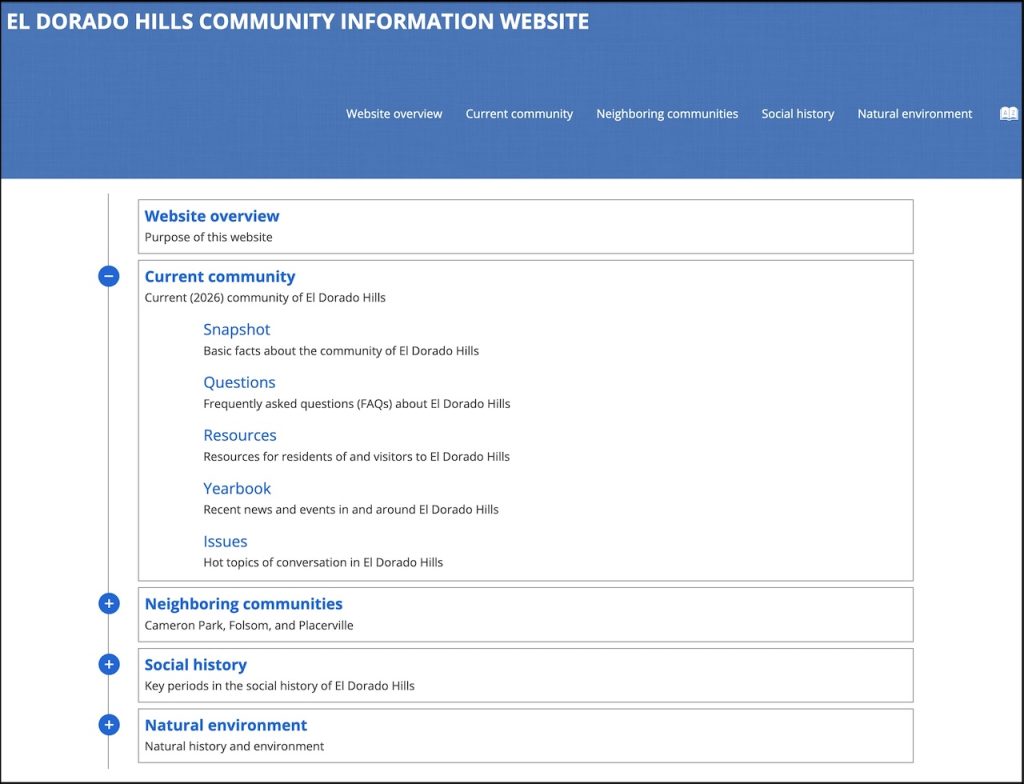
Information quality depends on credibility, so beginning with an existing, validated knowledge base gave our EDH community information website a reliable foundation.
We were lucky to be able to start that project with the book we had created ourselves, in 2003, about El Dorado Hills. Although some of the information was out of date, it served us well in our initial prototype and subsequent first draft of the WebHelp Responsive website.

Here are some key advantages we had with such an existing knowledge base:
- It ensured consistency, accuracy, and completeness during early development of the community information website.
- Using a known source made it easier to integrate human and AI content creation workflows while maintaining validation checks.
- The knowledge base acted as a training/benchmarking tool for onboarding contributors.
Where might you find existing information that could serve as a knowledge-base starting point for your community information website?
Information available to your prototype collaborative team could include the following:
- Books written about the history of your community
- Flyers distributed by your local library about community events and services
- Brochures distributed by your chamber of commerce or local real estate organizations
- Signage about your community that appears in local parks or other public areas
- Newspaper articles documenting local events and organizational activities
Here are a few examples that we collected recently on a visit to Windsor, California, one of our neighboring communities.


Legacy information from multiple sources and used for many purposes, transformed into a “known-by-everyone” information source in “available-to-everyone” electronic format on a website, makes it easier to keep track of, update, and use the information for other purposes.
For example, the “pioneer families” information could be used by a teacher working on a history unit or by a local historian giving a presentation to a service club. The CalFresh information could be used by a church outreach organization helping members find out about services valuable to them and their families.
How could you get started with your own collaborative community information project?
A initial knowledge base, consisting of a dozen or so existing local information “snippets” like the ones described above, and transformed to a DITA project similar to the model/template of the site we did for El Dorado Hills, could give you all you’d need for an early prototype.
Our EDH WebHelp Responsive website is hosted on our existing, professional site, VRJAssociates.us. A new site and domain name is NOT needed at this early stage of the project.
Having a working prototype, loaded with information about YOUR community, could go a long way in convincing your local leaders how valuable such a project could be!