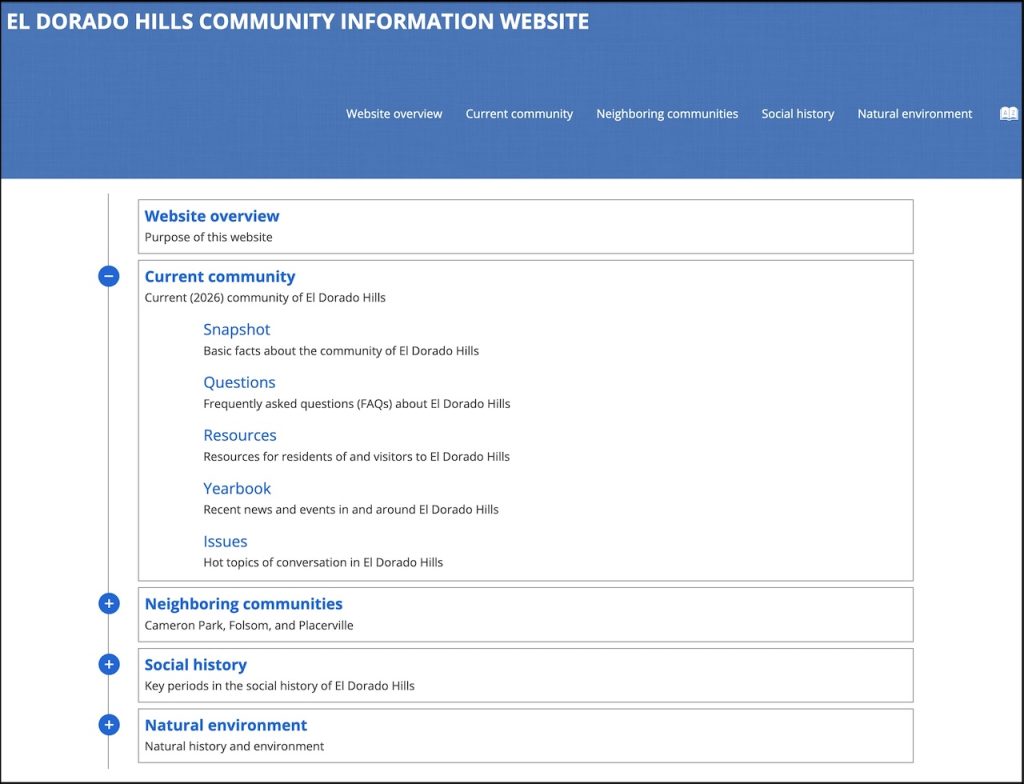
The EDH community information project is a structured, DITA-based local knowledge base for El Dorado Hills, California — published using the Oxygen WebHelp Responsive format. It’s designed so residents, visitors, and local organizations can explore trusted, well-organized information about the community.
Beyond that, it serves as a model for other communities and organizations interested in planning and building similar local knowledge systems.
The project, including this post, are being developed as a joint effort between us and various AI assistants, including Perplexity AI.
Explore the external version of the project
What is DITA?
DITA (Darwin Information Typing Architecture), is an XML-based architecture for authoring, producing, and delivering information as discrete, typed topics. It was first adopted by large organizations (starting in the mid-2000s) for complex technical and scientific documentation, typically published as online help, customer support content, or print-ready files.
We ourselves were working with DITA during that time: we wrote some of the documentation for DITA and the DITA Open Toolkit, which was used to process DITA files.
DITA has made complex content management accessible — it’s not just for big corporations anymore.
Today, DITA is used well beyond traditional software and hardware documentation; it underpins training materials, policy libraries, knowledge bases, and other modular content collections. Its topic-based, reusable structure makes it a strong fit for modern, collaborative, AI-enhanced projects where information needs to be accurate, adaptable, and easy to repurpose.
For “everyday” community information, DITA’s building blocks — topics, maps, and metadata — help keep content small, mix-and-matchable, and easy to update as people, organizations, and priorities change.
Key benefits of using DITA:
- Structured content enables scalability, reuse, and consistent formatting across many pages, projects, and audiences.
- Writers don’t need to be deep tech experts — just familiar with concepts like topics, maps, and a shared metadata model.


- Using DITA helped clarify roles: subject-matter experts focus on facts, editors focus on clarity and structure, and AI systems can assist with search, summarization, and reuse.
- Once defined, a DITA-based collection becomes a “replicable template” that other communities or organizations can adapt for their own knowledge bases.
Some concrete benefits of building on DITA:
- Standards-based solution: DITA is an open OASIS standard, supported by multiple tools and vendors, which reduces lock-in and increases long-term durability.
- Single source, many outputs: The same topics can be published to multiple channels (for example, WebHelp Responsive sites, PDFs, and other formats) without rewriting.


- Topic-based reusable content: Content is authored in standalone topics that can be reused across documents, collections, and knowledge bases, which simplifies maintenance and improves consistency.
- Customizable presentation: Publishing templates (for example, in WebHelp Responsive) allow branding and layout customization while keeping the underlying content structure stable.
- Built for collaboration: Clear structures, roles, and metadata make it easier for multiple groups — to review, improve, and reuse content across teams and organizations.

- Ready for automation and frequent updates: Structured, modular topics are easier to validate, transform, and integrate into automated workflows for updating and republishing.
- Scales over time: As the content grows (more topics, more contributors, more outputs), the underlying model stays the same, which supports long-term growth without a complete redesign.