The EDH community information project is a structured, DITA-based local knowledge base for El Dorado Hills, California, published using the Oxygen WebHelp Responsive format. It is designed so residents, visitors, and local organizations can explore trusted, well-organized information about the community.
Beyond that immediate purpose, it serves as a model for other communities and organizations interested in planning and building similar local knowledge systems.
The project, including this post, are being developed as a joint effort between us and various AI assistants, including Perplexity AI.
Links to the two websites
There are actually two versions of the website:
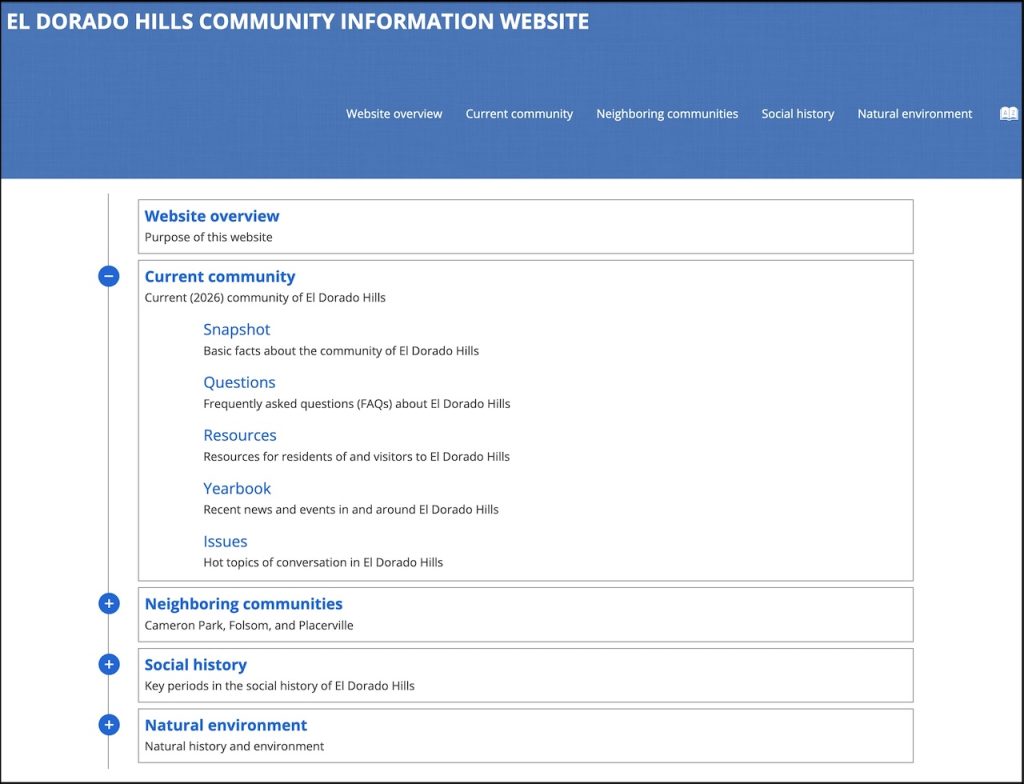
- An “external” website containing content available to general audiences
Explore the external version of the project
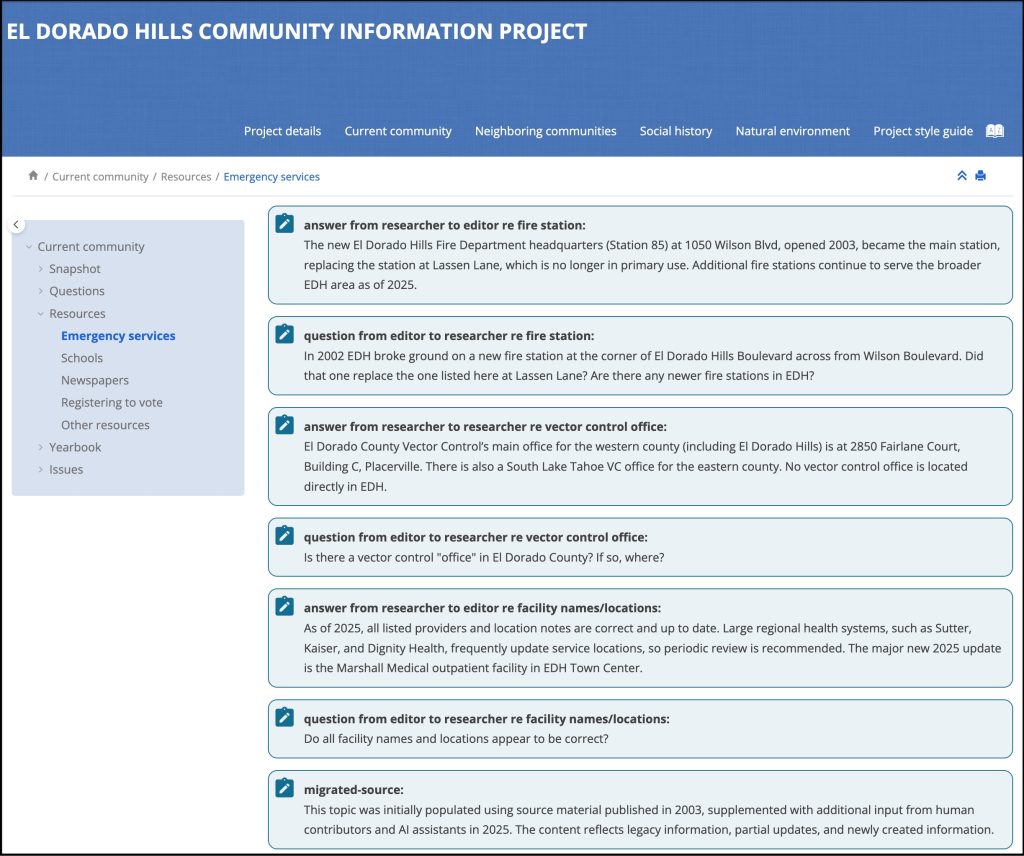
2. An “internal” website containing the external content plus “behind the scenes” information relevant only to the collaboration team
Explore the internal version of the project
Translation, automation, and update strategies that support key community information project goals
This final post in our El Dorado Hills series aligns with two of our core EDH project goals:
- Use artificial intelligence (AI) to generate and update community-oriented information.
- Machine-translate topic-oriented projects from English into other languages using AI-driven tools.
Automation for sustainability
Future efficiency through AI-driven processes will ensure that the project evolves without constant manual effort.
- Routine updates — like new community data, event info, or standard descriptions — can be semi-automated via data feeds, APIs, or scripts integrated with DITA structures.
- AI models will detect outdated content by comparing against live sources and suggest revisions using advanced prompting techniques.
Example prompt
“Compare this external news [paste source] to our trusted knowledge base [paste knowledge base excerpt]. Identify discrepancies, suggest updates, and explain changes while prioritizing local verified facts.”
- DITA-based structure future-proofs content for new formats, AI integrations, and automated publishing pipelines.
- Import effective prompting practices: Write clear, specific prompts with context, examples (“few-shot”), and step-by-step instructions for best AI results.
Example prompt
“As an expert editor, revise this text for clarity: [text]. Use active voice, short sentences under 20 words, no jargon.”
- Maintain effective models, templates, and sample text repositories for consistent AI outputs.
- Build a knowledge base with trusted local information; prompt AI to cross-verify external data against it for accuracy.
Machine translation for inclusivity
Include non-English-speaking community members in creation and consumption by prioritizing accessible, translatable content.
Suggested workflow
AI machine translation (MT) generates first drafts, followed by human post-editing (MTPE) for accuracy, cultural sensitivity, and community review.
General guidelines
- Boost MT quality with “Simplified Technical English” (STE) or plain language: short sentences (15-25 words), active voice, no slang/jargon/gerunds, controlled vocabulary.
- Avoid passive: “The meeting is attended by volunteers.” → “Volunteers attend the meeting.”
- Conditions first (not buried in middle): “If power is off, check the fuse.”
Translation example
MT Example (English to Spanish, community info):
Original (Simplified): “Volunteers meet every Tuesday at the community center. Bring your ID.”
Machine Translation: “Los voluntarios se reúnen todos los martes en el centro comunitario. Traiga su ID.”
Strategic updating
General guidelines
- Plan update frequency up front: e.g., weekly for events/government services, quarterly for descriptions.
- Tag frequent-change info (current services, events) vs. static (history, bios) in DITA for targeted AI/data feed updates.
- AI-assisted: Schedule scans for staleness, automate pulls from official sources, flag for review.
Following the above strategies will help you position your community information projects for scalable, inclusive growth in an AI-powered future.